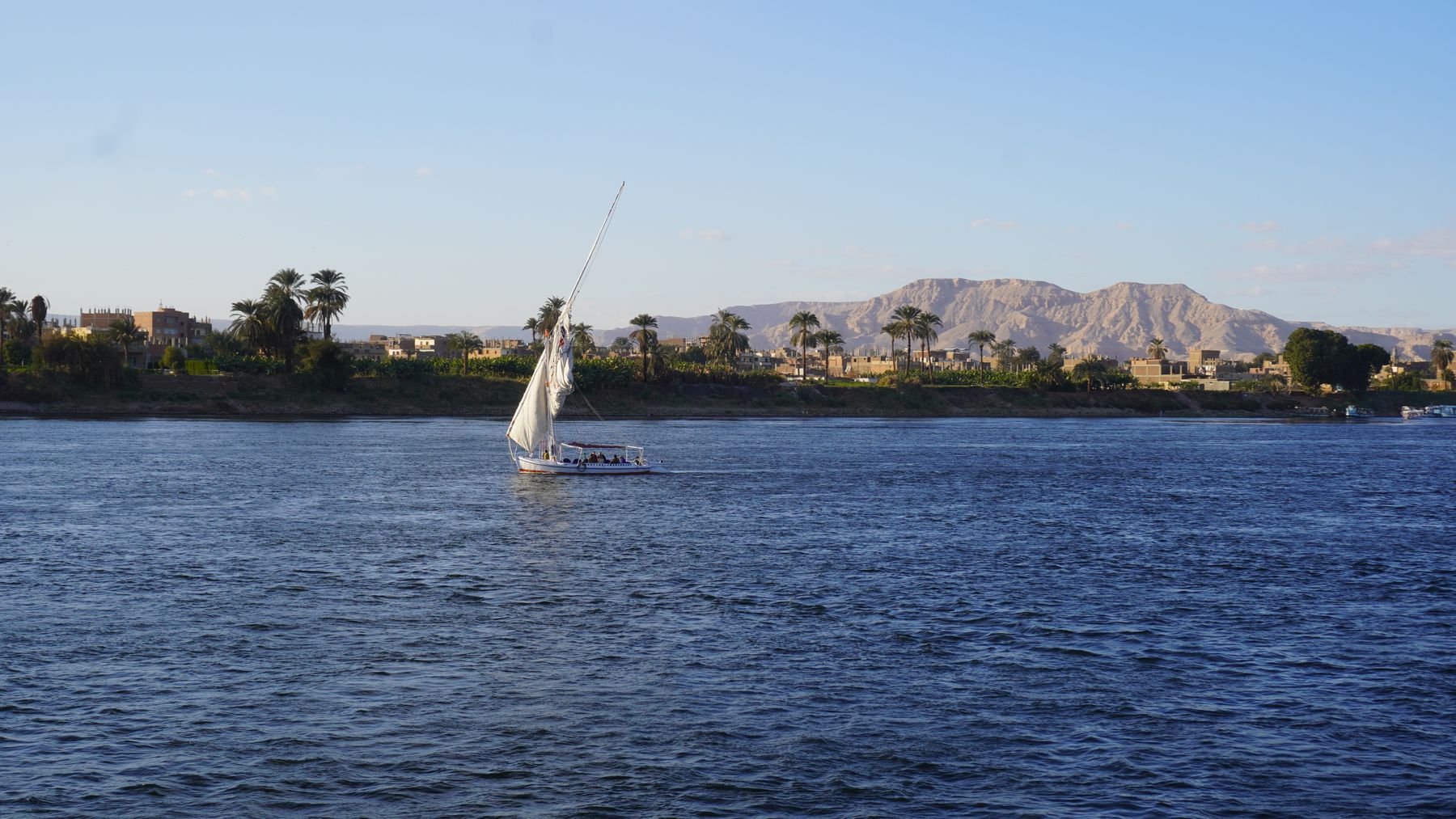
October and November are a transition: October still carries summer heat, November is cooler but busier. Days are warm, mornings and evenings are comfortable. The Nile splits the city, so plan East Bank mornings for Karnak and Luxor Temple, and West Bank mornings for tombs and mortuary temples. Book hotels and balloons early for November, and check opening hours for your dates because they shift seasonally.
Why the shoulder season works this way
Luxor sits in a desert climate, so the shift from October to November is a drop in temperature rather than a change in weather. October holds onto summer heat: daytime highs are still high enough that exposed sites become uncomfortable by late morning, and the difference between sun and shade is large. November brings cooler air, especially after sunset, when a light jacket becomes useful. Rain is rare in both months, so the practical question is heat and daylight, not rain cover. Because the Nile splits the city, the east bank and west bank have different best times, and the season changes how much that timing matters.
The split also shapes how a day is built. Karnak and Luxor Temple are on the east bank, close to the railway station and most hotels. The tombs and mortuary temples are on the west bank, reached by ferry or bridge. In October, the west bank needs the earliest possible start because the tombs hold heat and the paths between them are exposed. In November, that pressure eases, but the daylight window is shorter, so an early start still pays. Crowds follow school holidays and weekends more than the calendar month, which is why the same week can feel different from one year to the next.
Options by week and month
The six periods below differ in heat, crowds and how early you need to start, so match the choice to what you want from the trip.
How to sequence the booking
Work through these in order, because accommodation and balloon availability constrain the dates more than the sites do.
Three assumptions to leave behind
What to plan for each month
For early October, treat the month as an extension of summer. Plan site visits for the first hour or two after opening, when temperatures are lowest and light is soft. The Valley of the Kings and the mortuary temples at Deir el-Bahari and Medinet Habu are west bank sites, so those mornings should be kept for the west bank. Afternoons are better for indoor or shaded activities: the Luxor Museum, the Mummification Museum, or a hotel garden. Late October begins to ease, but the change is gradual, so do not assume the last week will feel like November.
November is the more comfortable month, but it is also busier, particularly around half-term and weekends. Accommodation and balloon flights fill earlier, so booking before fixing dates is sensible. Mornings and evenings are cool enough for a layer, while midday remains warm. The east bank works well for late afternoons: Luxor Temple is open into the evening, and its lighting makes a visit after dark practical. For river crossings, the public ferry runs between the east bank near Luxor Temple and the west bank near the ferry landing, and it is the simplest way to cross without a vehicle.
The public ferry crosses between the east bank near Luxor Temple and the west bank near the main landing, and it runs through the day and into the evening. A road bridge also connects the banks further south. Hours change seasonally, and the last crossing can be earlier than expected, so check the operator's page for your date before relying on a late return.
When the obvious answer is wrong
October half-term and November weekends are the obvious times to avoid if you want fewer people, but the more common mistake is treating October as a cool month because it is autumn in Europe. In Luxor it is not. The second wrong assumption is that November guarantees comfort at every hour: midday can still be warm, and sites with little shade remain tiring. The third is trying to combine both banks in one day. The river crossing and the distance between sites make that rushed, and the heat or the shorter afternoon light will decide which part you miss.
The busiest periods are not always the ones the calendar suggests. Egyptian school holidays, European half-terms and long weekends can overlap, and the effect is concentrated on the west bank in the morning and on Karnak in the late morning. If your dates are fixed around a weekend in November, plan the west bank for the earliest ferry and leave Karnak for the afternoon, when tour groups have largely moved on. If your dates are flexible, midweek in late October or early November often gives cooler air without the peak weekend pressure.
Questions
Is October or November better for Luxor?+
November is cooler and more comfortable, but October is quieter and still manageable if you start early and rest at midday. The trade-off is heat against crowds. Both months work, so pick based on whether you tolerate heat or crowds less. For a broader timeline, see the seasonal overview.
How hot is Luxor in October?+
Daytime temperatures in October are typically warm to hot, with cooler mornings and evenings. The exact figures vary year to year, so check a forecast close to your date. Plan outdoor sites for early morning and late afternoon. If you are sensitive to heat, November is the safer choice.
Do I need to book the Nile ferry in advance?+
No, the public ferry between the East and West Banks runs frequently and you pay on board. Private boats are available on demand and can be arranged at the Corniche. Just confirm the last crossing time if you plan to return after dark. The Corniche walk is a good place to start.
What should I pack for Luxor in November?+
Pack light layers for warm days and cool mornings, plus sun protection. Evenings can be chilly, especially on the river. Comfortable shoes matter because sites involve uneven ground. A scarf or hat helps at exposed sites like the Valley of the Kings.
Are balloons operating in October and November?+
Balloon flights over the West Bank usually operate in both months, but they depend on wind and visibility. Flights are often early morning and can be cancelled at short notice. Book through a reputable operator and keep a backup morning free. Check the balloon page for current details.